
Lee Locations around the world 


Follow The Lee Company


Effective filtration is essential to system performance, particularly in applications where even small amounts of debris can cause significant damage. Flange mount safety screen filters serve as a final barrier to protect critical components from contamination, but their effectiveness depends not only on how well they can filter out contaminants, but also on how securely they can be retained. Without proper retention, screens may migrate or dislodge, allowing contaminants to bypass the filter and cause damage and downtime.
There is no one-size-fits-all retention method for every situation. Instead, several approaches are used in practice, each balancing strength, stability, and serviceability in different ways. Not sure which retention method to use in your application? In this article, we’ll walk you through five common approaches so you can confidently retain your flange mount safety screen filter.
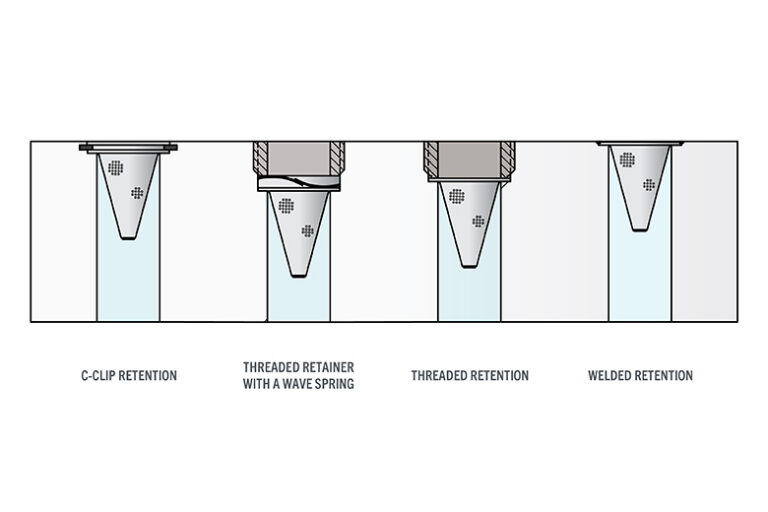
C-clip retention is a simple, low-cost method that uses an open-ended metal ring installed in a machined groove to hold the safety screen filter in place. Internal snap rings are commonly used for this type of design. During installation, the ring is compressed with a tool, inserted into the groove, and then released so it expands outward and snaps securely into place.
This method works best in low-pressure applications where ease of installation and removal is important. Because of its simplicity, C-clips are quick to install and remove, making routine maintenance — such as cleaning or replacing the safety screen filter — easy. They are also lower in cost than threaded retainer designs, as they require fewer components and less machining.
Of course, this design isn’t without its limitations. C-clips provide limited holding strength and are not suitable for high pressure applications where the safety screen filter could be forced out of position. Because the clip does not compress the screen flange, some movement can occur during operation. This lack of compression often leads to the use of supplemental features, such as wave springs, to improve stability.
A threaded retainer with a wave spring locks the safety screen filter in place while maintaining constant pressure on it. This combination helps take up tolerance variation and prevents movement or rattling during operation.
This method works well in moderate to high pressure applications where both reliability and serviceability are important, especially in systems experiencing temperature changes or minor part variation. The spring maintains consistent pressure over time, while the threaded retainer allows for relatively easy removal when maintenance is required.
It also introduces some added complexity. This design requires proper torque during assembly and careful wave spring selection to achieve the desired preload. Material compatibility is also important, as mixing dissimilar metals between the retainer, spring, and housing can lead to corrosion or wear if not properly managed.
Threaded retention uses a ring or nut that screws into the housing to secure the safety screen filter in place with a controlled amount of force. The screen sits between a shoulder in the housing and the threaded retaining ring. Tightening the ring applies a consistent clamping force that holds the safety screen filter firmly in position and resists movement caused by pressure spikes and flow changes.
This method is reliable across a wide range of applications and supports straightforward maintenance. The retaining ring can be removed using standard tools, allowing the safety screen filter to be inspected, cleaned, or replaced without damaging surrounding components.
At smaller scales, however, thread clearances can create potential pathways for foreign object debris (FOD) to bypass the screen. Threads must also be machined accurately to avoid cross-threading or poor engagement, which can compromise retention. Material compatibility is another factor that must also be considered, as differences in corrosion resistance or thermal expansion between components can affect long-term performance.
Welded retention permanently secures the safety screen filter to the housing, preventing it from moving or coming loose. The screen is typically welded around its outer edge, creating a fixed assembly sealed at the perimeter. This method provides the best protection against bypass leakage and eliminates the risk of components loosening over time due to vibration, pressure cycling, or temperature changes.
It is often used in applications where maximum reliability is required and the safety screen filter does not need to be removed. However, it is important to note that welded safety screen filters are not serviceable — the screen cannot be removed or replaced without destroying the assembly. The welding process also requires careful control to avoid damaging the safety screen filter or distorting the housing, particularly with thin or delicate materials. In addition, materials must be compatible for welding, and the process generally requires more manufacturing effort than removable retention methods.
A common alternative to welded and threaded retention is block-to-block retention, which secures the safety screen filter by clamping its flange between two adjoining manifold sections. When the manifold blocks are fastened together, the interface surfaces apply a rigid, uniform clamping force that holds the screen securely in place. This prevents the screen from shifting under pressure or vibration while eliminating the need for additional hardware such as threads, welds, or snap features.
This approach is commonly used in systems with multi‑piece manifolds or split housings, where the screen can be captured within the assembly interface. Because the screen is retained as part of the joint, it benefits from the inherent structural stability of the assembly. Eliminating threaded components also removes risks of thread wear, cross‑threading, or potential FOD pathways associated with small thread clearances, while avoiding the permanence of welded retention. Serviceability is also straightforward: opening the manifold joint provides direct access to the screen for inspection, cleaning, or replacement without the need for specialized tooling.
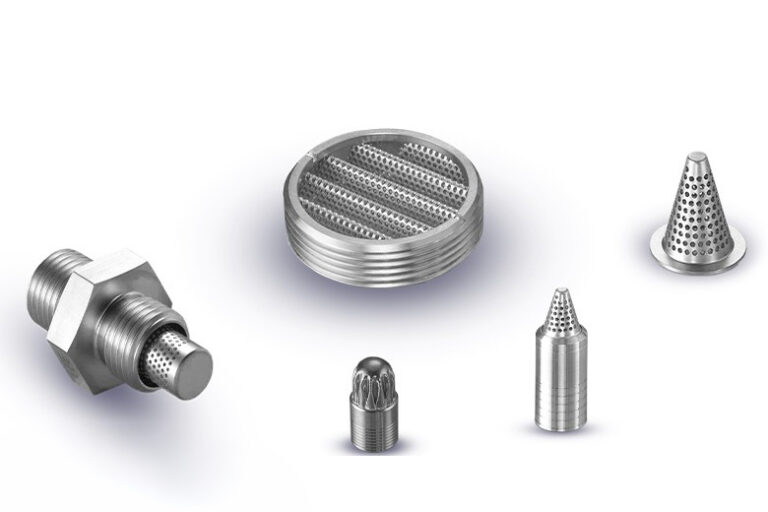
The Lee Company offers a variety of standard safety screen filter designs spanning a wide range of sizes, materials, retention methods, filtration ratings, and even technology.
The best retention method depends on your specific operating environment. Five key factors should guide your decision: pressure, vibration, temperature variation, maintenance requirements, and cost.
Higher pressure systems typically require more secure retention, such as threaded designs or threaded retainers with wave springs, to prevent the safety screen filter from moving. Lower pressure applications, by contrast, may be well-served by simpler, more cost-effective solutions like C-clips.
Vibration and thermal changes also play a role in performance over time. Retention methods that maintain consistent clamping force or provide permanent attachment help maintain stability under significant vibration and thermal changes.
Maintenance is another critical consideration. For applications requiring regular cleaning or replacement, removable retention methods such as C-clips or threaded retainers provide easier access. In contrast, welded retention offers maximum security but is best suited for applications where serviceability is not a priority. Block-to-block retention occupies a middle ground, providing robust retention while still allowing access for inspection, cleaning, or replacement.
Ultimately, selecting the right method is about balancing performance with practicality. The right choice ensures your safety screen filter stays securely in place — protecting your system from damage and supporting reliable, long-term operation.
Safety screen filters help protect your system’s most critical components from contamination — but only when they remain securely in place.
With more than 75 years of precision flow control expertise, The Lee Company helps engineers like you meet this challenge with confidence. We partner with you to identify the right flange mount safety screen filter for your application, considering pressure conditions, dynamic loads, material compatibility, and manufacturability.
Our broad portfolio spans multiple materials and configurations, offering flexibility across retention methods and operating environments. Each solution is tailored to meet defined performance requirements and validated through testing that reflects real-world conditions, helping ensure consistent, long-term performance.
Because execution is just as critical as design, our global presence allows us to deliver local technical support at every stage, from prototyping through full-scale production.
Explore The Lee Company’s range of flange mount safety screen filters to find the right fit for your application.
Save time and streamline your design process with a tool built for fast and accurate safety screen filter selection.
Always verify flow calculations by experiment.
*There are many parameters to consider when determining V-Factor. Click here for more information.
 FAQs
FAQs 

