
Lee Locations around the world 


Follow The Lee Company


Hero Image Source: ZeroAvia
ZeroAvia, an award-winning leader in hydrogen-electric aviation, successfully replicated a full flight profile in ground testing of its fuel cell power generation system—a critical step toward engine certification. The Lee Company’s engineers played a key role in this accomplishment, working closely with ZeroAvia’s team to develop an eductor, also known as a Venturi ejector, that helped improve the safety, reliability, and performance of the fuel cell system.
In 2023, aviation accounted for 2.5% of energy-related CO2 emissions globally, according to the international energy agency. ZeroAvia is working towards a clean future for the aviation industry by developing electric propulsion technologies to unlock lower costs and emissions, cleaner air, reduced noise, energy independence, and increased connectivity. The company is developing hydrogen-electric fuel cell-powered engines for commercial aircraft as well as supplying hydrogen and electric propulsion component technologies for electric air transport applications.
ZeroAvia is pioneering the development of powerful and highly efficient low temperature proton exchange membrane (PEM) fuel cells that convert hydrogen energy into electricity with zero emissions. Typically, an electrically driven blower is used to support the recirculation of unconsumed hydrogen within a PEM fuel cell system. This solution consumes energy supplied by the fuel cell and adds design complexity to the system, along with the need for regular maintenance.
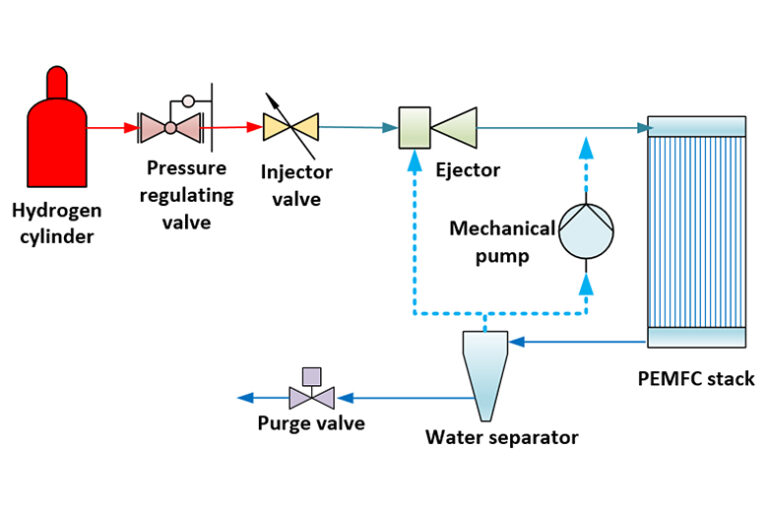
An example schematic showing how an eductor can be used to recirculate hydrogen in a PEM fuel cell system. (Image Credit)
To simplify and improve the performance, efficiency, and reliability of ZeroAvia’s fuel cell system, a passive eductor can provide the same function as a blower using the Venturi effect – and do so without needing a power source, moving parts, or maintenance. The benefits of an eductor over a blower are well-known and discussed in literature on PEM fuel cells. Despite these advantages, creating an eductor that can successfully recirculate unconsumed hydrogen in this type of application has been recognized by industry scholars as a significant challenge.
ZeroAvia recognized the benefits of using an eductor device in their PEM fuel cell, and turned to The Lee Company to provide a solution. There were two unique challenges that made this application more difficult than typical eductor use cases. First, Zero Avia’s PEM fuel cell system needed to perform efficiently across the wide range of operating conditions during take-off, climbing, and cruising. This means that the performance of the eductor must be balanced to work well for multiple performance points. Another difficulty with this application is that the eductor needs to flow multiple fluids. “Using hydrogen to draw a flow of gases like nitrogen and hydrogen with entrained water vapor is like trying to use golf balls to move a basketball” explained Daryl Retzke, Staff Engineer in our Restrictor Group.

Recognizing ZeroAvia’s need for a high performance eductor to support this innovative hydrogen technology, Lee engineers began working with their team on a solution. In conversations with the ZeroAvia team about their system and what they were trying to accomplish, it became clear that the existing theoretical equations about how eductors work – which are based on single-state flow – were not going to get us to the solution for such a novel application. According to Daryl, “theory got us into the ballpark, but we had to do a lot of development from that point on – a lot of experimentation and a lot of iteration”.
Because the performance of the eductor is influenced by other components in the system, it was important for our engineers to understand how ZeroAvia’s system would operate and be able to reproduce this performance in-house. With support from the ZeroAvia team, we learned critical details like their pressure and flow requirements, the path that the hydrogen would take through their system, the pressure drop across their components, and the fluids that they were working with. From there, Lee engineers replicated ZeroAvia’s test stand to perform bench testing under similar conditions. Jon Jewell, our Product Manager for Screens and Restrictors, explained that the test stand enabled much more efficient collaboration and a faster development timeline because “we were able to say ‘here’s the part to test, send us your results and we’ll replicate them here’” instead of relying solely on ZeroAvia for empirical data. While ZeroAvia was evolving the design of their fuel cell system, we continued to communicate closely so we could modify our test stand in tandem and always replicate the expected system conditions.
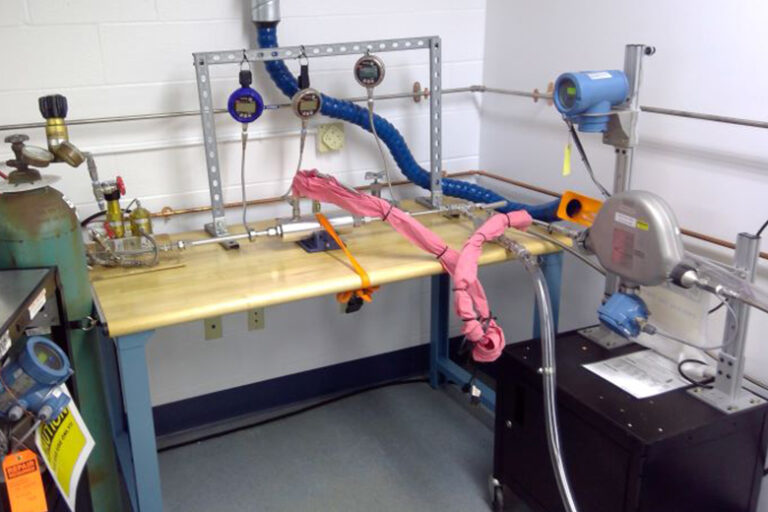
The bench test stand enabled us to speed up development time because we could recreate expected system conditions in house.
Our testing process started small, at a scale of 1/10th the flow of the customer’s system. As we got closer to a solution, we started working at scale and were able to provide 3D printed, and eventually metal, prototypes to ZeroAvia to test. In many cases, we were working under tight timelines and our engineers in the UK hand-delivered the prototypes to expedite testing.
Through this collaborative and iterative process, we were able to successfully create a solution that met ZeroAvia’s performance requirements. As he reflected on this engineering challenge, Lloyd Bailey, European New Products and Technology Manager of Lee Products Limited, remarked “we can’t change the laws of physics – but every once in a while, we do come close”.
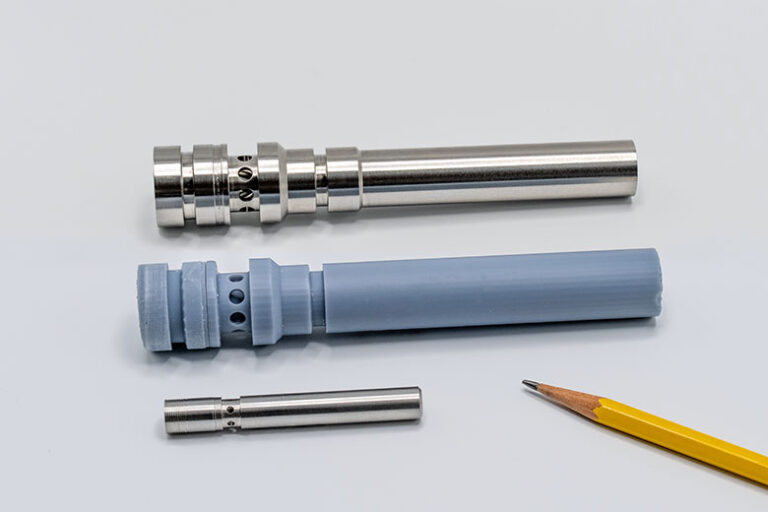
Shown top to bottom: a metal prototype, a 3D printed prototype, and a small-scale prototype used for bench testing.
Ultimately, Lee engineers successfully created and delivered a solution to ZeroAvia that could transfer the recirculated hydrogen fuel back into the system. This solution performed well in ground testing and is touted by ZeroAvia Founder & CEO, Val Miftakhov, as being a key innovation in the company’s fuel cell system. According to Val, “what we have achieved with the Venturi [eductor] is genuinely groundbreaking and further enhances an already commercially attractive, highly efficient and certifiable fuel cell propulsion system”.
Our team is thrilled to have helped solve such a novel engineering challenge and supported the development of a more sustainable power source for aviation. While we have extensive experience in the aerospace industry and our eductors are currently used in military aircraft that are in production today, this was a particularly challenging and rewarding project for our team. As Daryl put it, “this [solution] was the culmination of many decades of experience and knowledge from within The Lee Company…we had to use everything we’ve learned up to this point to make this one work”.
The Lee Company has been supplying eductors to a wide range of industries, including aerospace, for over 30 years.
In the fuel cell system, potential energy from the flow of hydrogen coming from the tank is converted to kinetic energy as it accelerates through a nozzle. This kinetic energy is used to induce the flow of the gas released by the fuel cell, converting the kinetic energy back to potential energy through the discharge of the new flow, which is now a mix of the recirculated flow and the new hydrogen from the tank. This allows the fuel cell to use every bit of hydrogen possible in the system, rather than wasting any hydrogen remaining when the flow is released from the fuel cell.
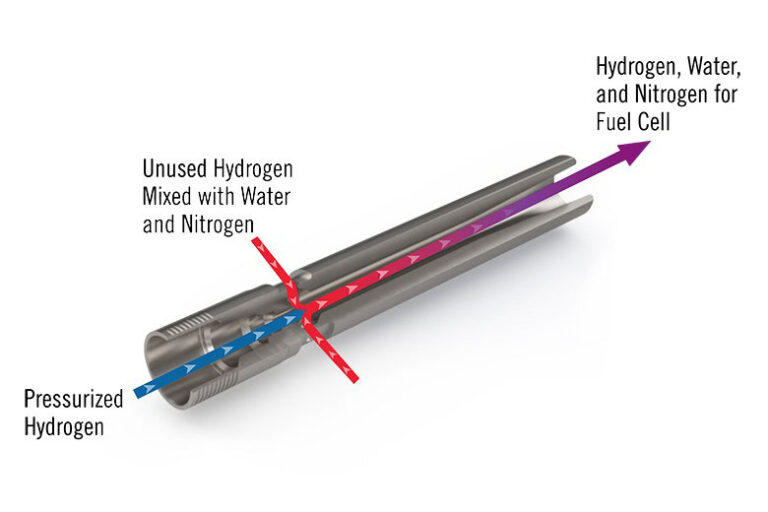
The eductor can be used to recirculate unconsumed hydrogen back to the fuel cell in a compact package without the use of seals, O-rings, or moving parts. This passive component requires no maintenance or electronics and is constructed of highly durable stainless steel. Ultimately, this solution helped the ZeroAvia team reduce the size and weight of their system and improve its reliability and efficiency by reducing system complexity.
Leveraging our local support team, engineering expertise, and extensive experience, along with our unique blend of rapid prototyping and in-house testing capabilities, we could be highly responsive to the customer’s needs and schedule. We were able to meet the evolving requirements of ZeroAvia’s fuel cell system so that their team was supported at every stage of development.
We are looking forward to continuing our work with ZeroAvia as they pursue certification for the PEM fuel cell that they plan to use on their ZA600 hydrogen-electric powertrain. We are excited to help the team solve other fluid control challenges that continue to evolve as they develop innovative hydrogen-electric technologies for the aviation industry.
There’s a reason why the world’s most innovative companies choose to partner with The Lee Company to solve their most difficult engineering challenges. Our engineers specialize in working one-on-one with our customers to help them streamline product development, identify efficiencies, and find solutions that enable groundbreaking technology. All parts are 100% functionally tested under a rigorous aerospace quality management system (AS9100) and our comprehensive development and revalidation procedures ensure they meet the highest reliability standards of the industry. When you work with our team, you can trust that we have the experience, engineering resources, and product breath to provide you with a proven solution – so your team can focus on system-level development.

Always verify flow calculations by experiment.
*There are many parameters to consider when determining V-Factor. Click here for more information.
 FAQs
FAQs 


