


Follow The Lee Company


For decades, neutralizing enemy air defenses meant sending pilots into the most dangerous airspace on the battlefield. Manned fighter jets and electronic warfare platforms ventured into hostile skies on missions where detection often meant death.
Destroying radar and missile systems that threaten friendly aircraft is a tactic known as Suppression of Enemy Air Defenses, or SEAD. These missions are dangerous, technically complex, and now increasingly carried out by machines. Unmanned Aerial Systems (UAS) can probe hostile defenses, map threats, and strike targets without risking human lives. They’re faster, they fly longer, and they’re getting more advanced.
The high-performance turbine engines powering these aircraft demand fuel delivery systems that can operate reliably under extreme conditions. But as defense organizations push for longer-range, faster, and more autonomous platforms, one unexpected component has become a limiting factor: the fuel pump.
In this article, we’ll explore the evolving role of UAS in SEAD operations, the importance of turbine propulsion, and why radial piston pumps offer critical advantages over conventional gerotor technology.
The battlefield is changing. Every SEAD mission carries significant stakes.
As air defense systems grow more sophisticated and lethal, sending pilots into contested airspace has become a risk no commander takes lightly. In response, militaries around the world are shifting these dangerous operations from manned aircraft to UAS. The advantages are clear: UAS platforms are covert, agile, and most importantly, expendable.
When a drone is destroyed in combat, equipment and investment is lost.
If a pilot dies in combat, a real human life is lost – along with years of training and irreplaceable experience.
These aren’t your typical remote-controlled aircraft.
Modern SEAD drones are equipped with advanced electronic warfare payloads, loitering munitions, and real-time data links that allow them to detect, jam, or destroy enemy air defense assets from great distances. They can operate autonomously or semi‑autonomously, reducing the need for direct pilot involvement and helping to preserve valuable lives. These systems can also deploy in coordinated formations or swarms, overwhelming enemy defenses through sheer numbers and tactical unpredictability – giving commanders the ability to engage threats dynamically and with greater precision.
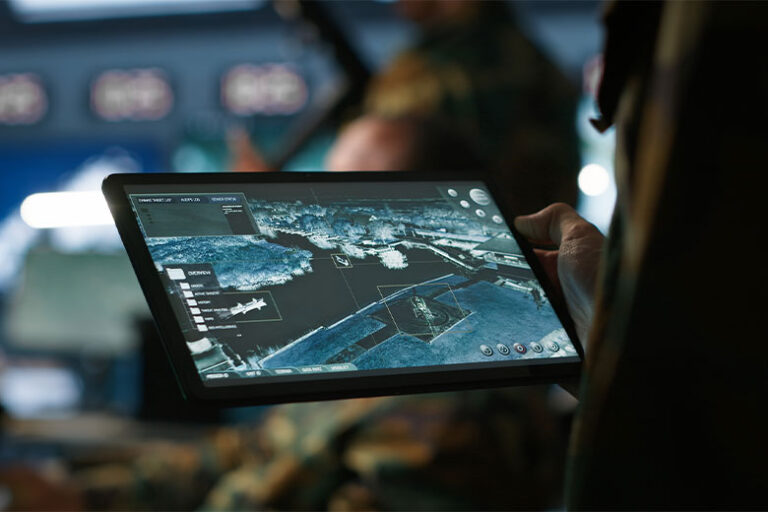
Without reliable performance from the UAS, mission success is impossible. A drone operating deep in hostile territory faces extreme conditions like high speeds, sudden maneuvers, temperature swings, and sustained operation without maintenance breaks. From propulsion to power management, every subsystem of the UAS has to work – every time, even under extreme stress. Failure is not an option.
Open a high performance UAS platform and you’ll likely find a turbine engine. These engines have become the preferred choice for advanced unmanned systems, and for good reason. They deliver substantial power with a high thrust-to-weight ratio, operate efficiently at high altitudes, and can sustain flight for hours on end. This makes them well-suited for surveillance, strike, and SEAD missions requiring rapid response and extended loiter times.
They’re also remarkably robust, whether operating over desert terrain in extreme heat or cruising through sub-zero air at 40,000 feet. They respond quickly to throttle inputs and function reliably even in harsh environments – a crucial advantage for SEAD missions where precise timing and dependable performance are of paramount importance.
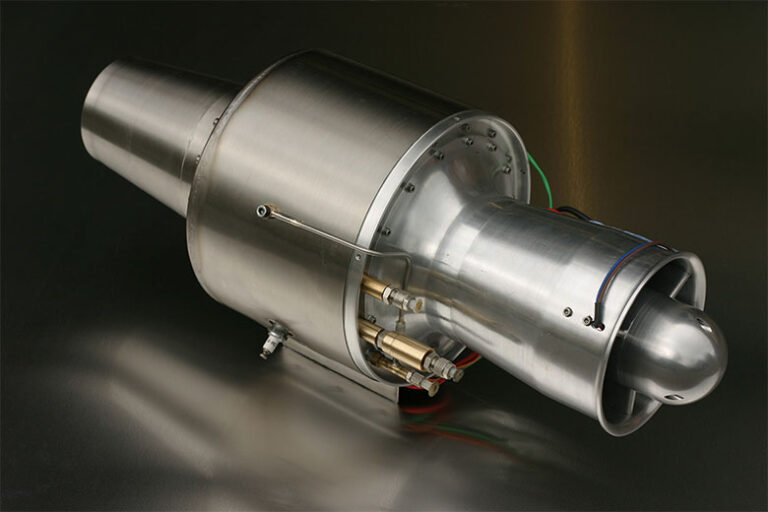
But even the most capable turbine engine is only as strong as the systems that support it. The fuel delivery system keeps the engine running by providing a steady, high pressure flow. Without it, stable combustion and optimal thrust cannot be maintained. Any interruption or irregularity in fuel flow can lead to performance degradation, engine flameout, or even mission failure.
That’s where the fuel pump comes in. It’s a small component, but it plays an outsized role in keeping the engine performing as required.
In a turbine engine, the fuel pump is responsible for delivering fuel at high pressure and with exacting consistency. This precision enables rapid throttle response changes and ensures predictable engine response during mission-critical phases. In UAS platforms, the challenge is even greater. Fuel pumps must also contend with extreme environmental conditions – from high altitudes and temperature fluctuations to vibration and shock during launch and maneuvering.
Architecture matters. Which fuel pump style you select can significantly impact the reliability, efficiency, and longevity of the entire propulsion system.
Two of the most common types of fuel pumps used in aerospace applications are gerotor pumps and radial piston pumps. Both pumps move fuel. However, SEAD mission conditions expose their fundamental differences.
Gerotor pumps (also known as internal gear pumps) are compact and relatively simple in design, making them a popular choice for many low- to mid-pressure applications. However, their fixed internal clearances can cause intolerable flow loss when system pressures increase or fuel viscosity changes, compromising fuel delivery consistency in turbine engines. These flow losses vary unpredictably between individual pumps, forcing engineers into an uncomfortable trade-off: accept significant flow errors across the flight envelope, or calibrate every unit in production. The result is often a patchwork of control profiles for different altitudes, temperatures, and fuel types. Additionally, gerotor pumps are more susceptible to internal leakage and wear over time – especially in environments with fluctuating loads and temperatures.
Radial piston pumps, by contrast, are engineered for high pressure, high precision applications. Their design allows for tight tolerances, minimal internal leakage, and superior volumetric efficiency, reducing flow loss across the operating range. They respond directly to voltage input, ensuring consistent fuel flow across variations in altitude, temperature, and speed.
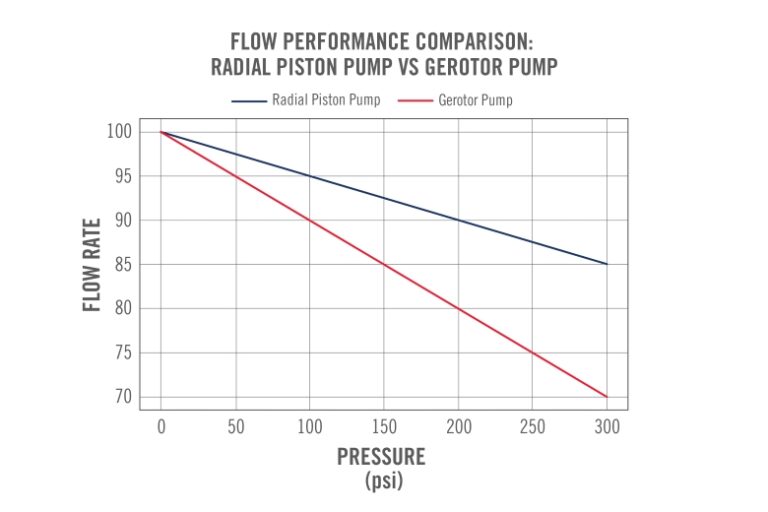
The graph above depicts the flow performance of a Lee radial piston pump when compared to a common gerotor pump for the same application.
For UAS turbine engines that demand reliable, high pressure fuel delivery, radial piston pumps provide the optimal solution. These pumps maintain precise flow regardless of changes in the flight envelope, mitigating variability from operational or environmental conditions. Predictable unit-to-unit performance eliminates the need for complex calibration procedures.
These performance characteristics translate into three key operational advantages:
Fuel system reliability in SEAD missions comes down to one simple rule: the pump must deliver consistent flow no matter what the aircraft is doing. Everything else – calibration steps, control logic tweaks, maintenance schedules – depends on whether that requirement is met or just managed around. Radial piston pumps remove the flow fluctuations and complex calibration demands that limit gerotor pumps.
As unmanned SEAD platforms grow more capable, the fuel delivery systems supporting them must evolve in parallel.
Radial piston pump technology is proving more reliable, more efficient, and better suited for the demands of next-generation unmanned combat systems. They maintain consistent flow across wider pressure ranges, handle temperature extremes without performance degradation, and deliver the mechanical reliability that turbine engines demand during rapid throttle transitions and extended loiter periods.
These aren’t abstract advantages – they translate directly to mission capability. More predictable fuel delivery means simpler system integration, reduced maintenance intervals, and fewer points of failure in aircraft that operate autonomously in contested airspace.
Our radial piston pump family brings these benefits in a purpose-built package for high performance applications like UAS turbine engines. Designed to meet the demanding requirements of next-generation SEAD platforms, these radial piston pumps offer exceptional pressure capability, low leakage, and robust thermal performance while maintaining the precision and reliability these systems require. Whether powering next-generation unmanned systems or upgrading existing platforms, they deliver precise, repeatable fuel control – ensuring dependable performance throughout any mission.
When SEAD missions push boundaries, your fuel pump should keep pace. Connect with a Lee Sales Engineer to learn more about our radial piston pumps engineered for next-gen unmanned aerial systems.
Selecting the right supplier is critical to program success in defense environments where reliability and performance cannot be compromised. From extreme operating conditions to long lifecycle demands, every component must be engineered and validated for absolute dependability.
Watch our webinar to learn about solutions that offer increased design flexibility and improved system performance across critical defense applications. We will share best practices for transitioning away from traditional pyrovalves – what to use instead, how to make the switch, and ways to ensure mission success.
Always verify flow calculations by experiment.
*There are many parameters to consider when determining V-Factor. Click here for more information.
 FAQs
FAQs 


