

Follow The Lee Company


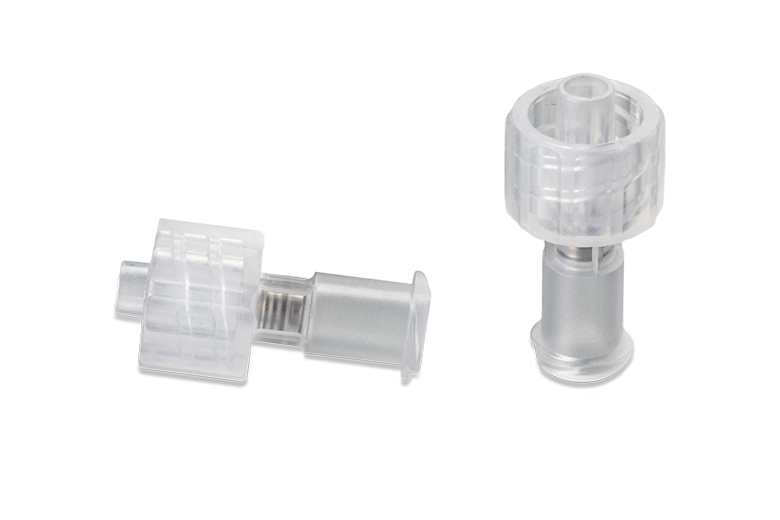
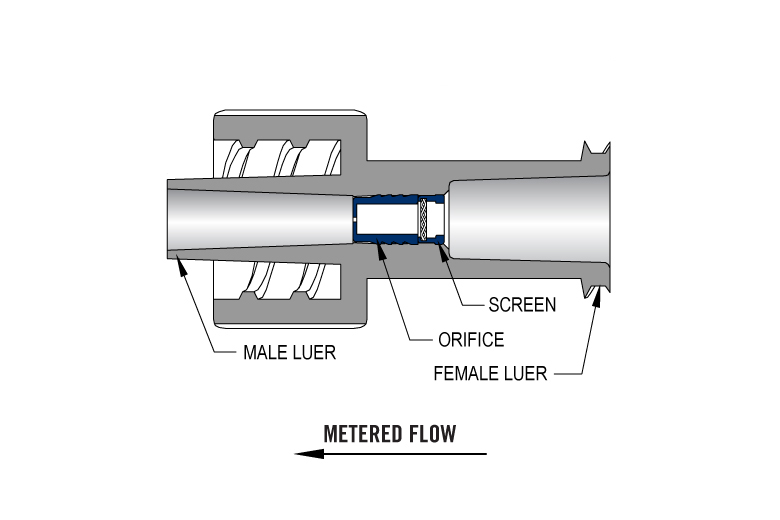
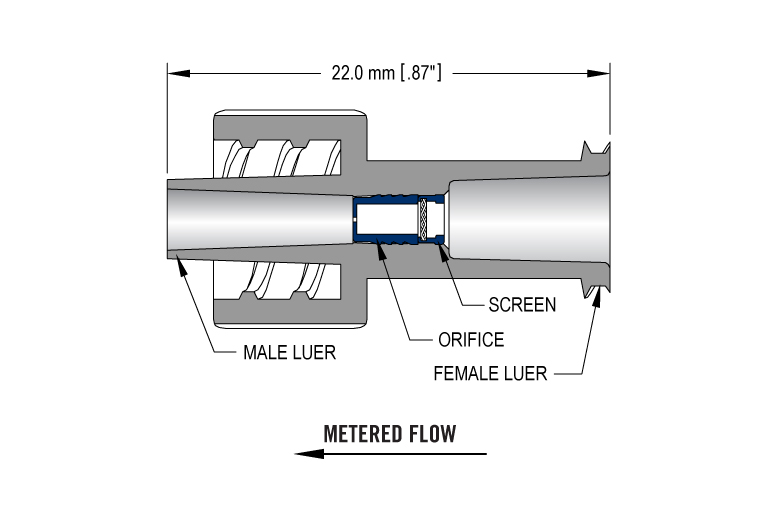
This highly accurate miniature flow restrictor is intended for gases. It is pre-installed in a male to female Luer fitting and includes a 40 micron safety screen filter to protect the orifice from contamination. Ideal for medical applications, both the orifice and screen are constructed of 300 Series stainless steel, while the fitting is composed of medical grade polypropylene. The orifices are all 100% flow tested on nitrogen to ensure each part is within ± 5% of its nominal flow rate.
| Characteristic | Specification |
|---|---|
| Lohm Rate Tolerance | ± 5% |
| Test Fluid | Clean & Dry Nitrogen |
| Screen Micron Rating | 40 microns |
| Maximum Working Pressure | Dependent on Housing Material, Configuration, and Operating Conditions |
| COMPONENT | MATERIAL |
|---|---|
| Fitting | Polypropylene - Natural |
| Orifice Body | 303 Stainless Steel |
| Screen Body | 303 Stainless Steel |
| Screen | 316 Stainless Steel |
This table below contains the part numbers and technical specifications for this product. If you have specific questions, need a quote, or would like to request a handbook or drawing, click the red request button in the column on the far right.
From plugs to solenoid valves, there’s a vast array of products that The Lee Company can offer. If you’d like to discuss the best solution for your specific application or to learn more about our capabilities, use-cases, or quality standards, contact your local Lee sales engineer.
Your download has started.
We’re always ready to be your engineering partner. Fill out this form below so we can provide the solution you need.
We have received your inquiry and a member of our team will be in contact shortly to provide more information. Thank you for contacting The Lee Company!
The Lee Company has developed the Lohm Laws for defining and measuring resistance to fluid flow. The Lohm is defined such that 1 Lohm will flow 100 GPM of water with a pressure drop of 25 psi at a temperature of 80°F.
Always verify flow calculations by experiment.
*There are many parameters to consider when determining V-Factor. Click here for more information.