
Lee Locations around the world 


Follow The Lee Company


Delivering fuel as a fine, consistent mist improves fuel-air mixing and overall performance, while inconsistent sprays can lead to wasted fuel and unstable combustion. Achieving this level of control requires a thorough understanding of how nozzle design input influences system behavior.
In this article, we’ll explore how turbine engine designers control fuel atomization by measuring and integrating designs to produce the right nozzle — examining how operating conditions vary performance, how atomization is quantified, and how performance can be maintained consistently in production.
Small turbine engines are widely used in compact propulsion systems ranging from unmanned aerial platforms to long-range munitions, where efficient fuel use directly impacts range, performance, and total operating cost.
The core challenge in these applications is creating a consistent, controlled fuel mist that enables reliable combustion. Changes in droplet size shift where combustion actually takes place within the chamber, leading to less efficient and less predictable results. If droplets are too small, they tend to burn too quickly near the injection point, which reduces overall combustion efficiency. If they are too large, they may not burn completely and instead travel further into the combustion chamber, leading to delayed and less efficient combustion.
But maintaining that level of control is complex. Spray behavior depends on operating conditions such as pressure, flow rate, temperature, number of nozzles, and fluid properties — all of which vary by application. Varying these conditions can lead to inconsistent combustion, which often has to be corrected with extra controls or components elsewhere in the system, adding to design complexity and cost.
That complexity is amplified in systems with multiple fuel nozzles. Small differences between nozzles can lead to variations in droplet size and distribution across the chamber, resulting in uneven combustion. Some regions may run hotter than others, creating hot spots where one nozzle is effectively burning hotter than the rest.
These temperature imbalances can drive secondary issues such as coking, soot buildup, and combustion instability. In more severe cases, they can even contribute to flameout. Maintaining consistent spray performance across every nozzle is the key to ensuring predictable, stable combustion.
Looking for a nozzle? Use the Product Finder to guide you to configurations that meet your requirements and gain access to detailed product information such as dimensions, performance specifications, CAD models, and more!
While fuel atomization can be adjusted based on engine performance feedback, that approach alone offers limited visibility into what is actually happening within the spray. Direct observation and measurement provide a more precise and reliable way to understand and control atomization.
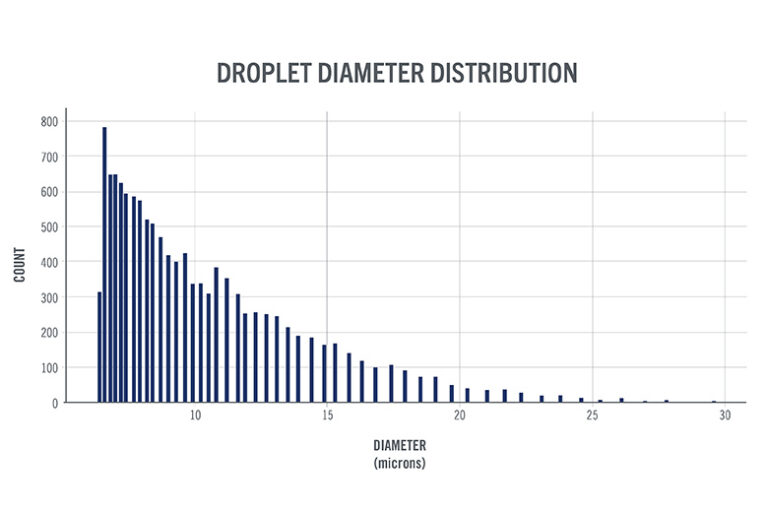
Spray sample analysis data from a Lee atomizing nozzle.
At The Lee Company, we use high speed imaging to capture real-time spray formation and distribution, providing a detailed view of how the spray behaves as it exits the nozzle. We then process this data using advanced analysis software to quantify droplet size, distribution, and key performance metrics such as droplet velocity and characteristic diameters.
Combined with extensive design verification, this approach serves as a development tool for our atomizing nozzles. It allows us to quickly iterate designs, verify performance, and confidently predict how a given design will behave under real operating conditions. It also enables us to provide detailed performance data when further validation is required.
One of the most important of these metrics is the Sauter Mean Diameter (SMD), a commonly used measure of droplet size. It represents the diameter of a hypothetical droplet that has the same volume-to-surface-area ratio as the entire spray:
Because the imaging system captures a full distribution of droplet sizes, SMD provides a single, meaningful value that reflects how that distribution will behave in real applications.
This makes SMD particularly useful for evaluating atomization quality. Since evaporation and combustion depend on available surface area, SMD effectively links the measured spray data to real-world performance. A lower SMD indicates finer droplets and greater surface area per unit volume, leading to faster evaporation, improved fuel–air mixing, and more efficient combustion. By contrast, higher SMD values signal larger droplets, which travel farther but evaporate more slowly and can reduce overall combustion efficiency.
In this way, SMD serves as a key bridge between measurement and design — it allows our engineers to interpret high speed imaging data in terms of injector performance and to make informed adjustments to nozzle geometry.
The insights gained from spray measurement feed directly into nozzle design, informing how internal geometry, flow paths, and operating conditions are refined to achieve the desired spray behavior. Rather than relying on theoretical performance alone, this process uses measured data to ensure that the nozzle produces a consistent, repeatable spray under real operating conditions.
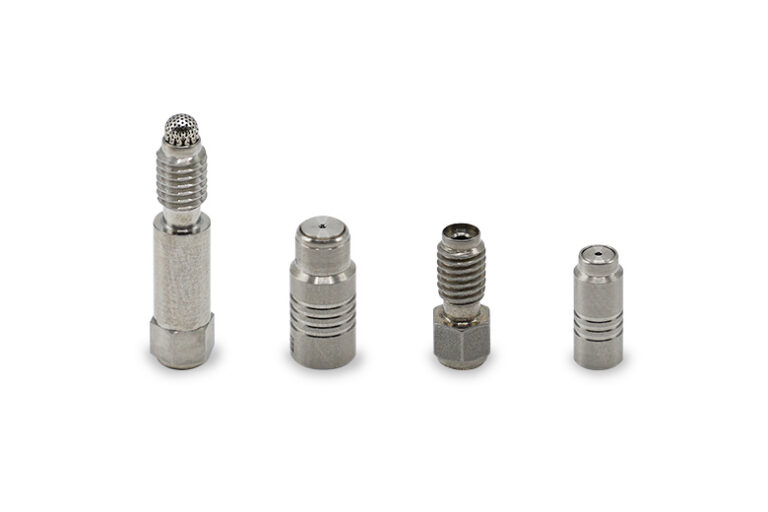
Lee atomizing nozzles are available in a range of standard options from 6000 to 18,000 Lohms, each equipped with a safety screen to protect against rogue particles.
Lee atomizing nozzles are designed with these principles in mind, translating measured spray behavior into controlled, repeatable atomization by:
Even with a well-defined nozzle design, carrying that performance through to production brings its own set of challenges. Each nozzle needs to deliver the same spray pattern so fuel is distributed evenly and combustion stays stable. When performance varies from one nozzle to another, combustion shifts as well — leading to uneven flame temperatures, localized hot spots, and a less uniform burn. Achieving consistent atomization in production depends on careful alignment between nozzle design, manufacturing methods, and validation processes.
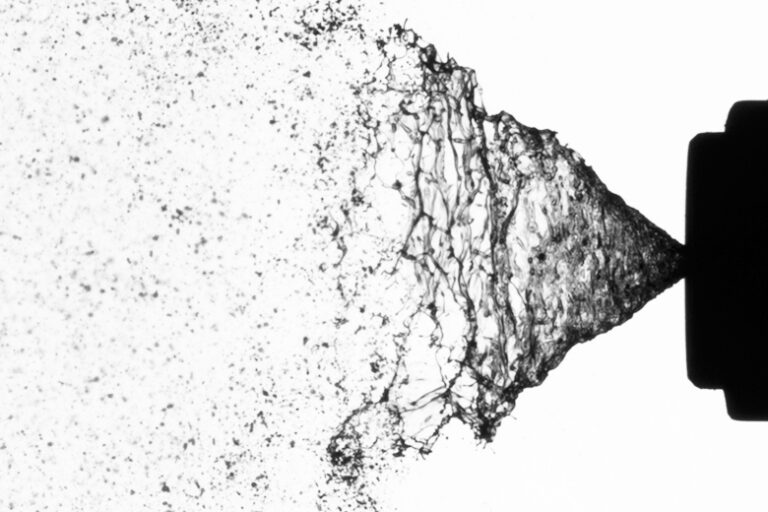
Designed for consistent, repeatable performance, Lee atomizing nozzles create a fine hollow cone or flat fan spray for even fuel distribution.
At The Lee Company, that starts with precision manufacturing techniques that preserve the internal geometry of each nozzle, ensuring critical flow features are reproduced accurately from part to part. From there, every component is tested prior to shipment to confirm it meets defined flow and performance requirements.
Because machining, assembly, and testing are all handled in-house, we’re able to tightly control quality and repeatability across production volumes. This helps ensure that spray performance remains consistent from one nozzle to the next.
Consistent atomization doesn’t come from nozzle design alone. It requires precise flow control, repeatability across production, and components that hold up under the pressures and temperatures of real engine environments.
At The Lee Company, we bring more than 75 years of expertise in microfluidics and precision flow control to help you achieve reliable, repeatable fuel atomization — even in demanding conditions.
Our atomizing nozzles are engineered to deliver both performance and scalability. That performance is strengthened by flexible design options — from integrated inlet safety screen filters in a robust configuration to fully application-specific solutions built for harsh operating environments. Custom designs are optimized to perform under difficult conditions typical of engines, backed by custom acceptance testing with a wide range of test fluids, custom flow rates and tolerances, multiple targets within a single design, and elevated temperature testing.
Lee engineers specialize in working with customers on an engineer-to-engineer level to navigate design and material complexities with confidence. Our global presence allows us to deliver local technical support that keeps development moving. Every Lee component is 100% functionally tested to ensure performance throughout your system’s lifecycle. Together, these strengths accelerate your path to innovation with components you can rely on.
Ready to unlock your engine’s full potential? Connect with a Lee Sales Engineer to discuss your turbine engine application.
Explore how Lee components integrate into next‑generation fighter aircraft across general, flight, engine, weapons, and landing systems. Use this interactive to discover how precision‑engineered solutions from The Lee Company work together to deliver reliability, responsiveness, and mission‑critical performance in the most demanding defense environments.

Always verify flow calculations by experiment.
*There are many parameters to consider when determining V-Factor. Click here for more information.
 FAQs
FAQs 


