


Follow The Lee Company


System designers are under increasing pressure to lower the overall ownership cost of instruments that direct fluid to and through microfluidic devices such as sequencing flow cells, PCR consumables, droplet-generation chips, disposable reagent cartridges, and organ-on-a-chip (OoC) devices. While syringe pumps and rotary valves are quite popular in these applications, they are also bulky, expensive, and require routine maintenance. This article will discuss the costs associated with syringe pumps and rotary valves and provide insights to help you choose the components that best align with the needs of your application.
While syringe pumps and rotary valves are popular components, they may not be the most economical choice for every system’s specific needs. Depending on your priorities in terms of the throughput, reagent use, and reliability of your system, you may be able to significantly reduce your operating costs using alternative fluid control architectures and components. System designers who explore other options can find highly capable, proven solutions that offer more design flexibility at lower costs.
Syringe pumps and rotary valves have parts that require maintenance or replacement. Downtime for repairs or to diagnose issues can be costly. That’s why our components are built to outlive the lifespan of your instrument. Our LPD Series piston pump can achieve 3.5 million cycles on DMSO while maintaining excellent precision and accuracy. Our LFN Series solenoid valve and Xover® pinch-tube valve have also demonstrated long life on challenging fluids such as DMSO, ethanol, Tween®, tris buffer, and others. Based on testing with water, the LFN valve is rated for 10 million cycles and the Xover valve is rated for 5 million. Pneumatic components can also be used to push and pull fluids through an instrument in a pressure-driven flow architecture. This reduces the chances of component failure due to contamination or compatibility issues. Our disc pumps and LHD Series solenoid valve are great solutions for these applications and offer a near-indefinite lifespan in low power applications.
Rotary valves and syringe pumps are relatively large components when compared to alternative system architectures. This presents a problem for designers who want to expand their testing capabilities without dramatically increasing the size of their instrument. For example, next generation systems often require independently addressing multiple flow cells at once.
In place of a rotary valve, customers can leverage manifold-mounted solenoid valves to select between reagents. Our LFN Series solenoid valve is 7 mm in diameter and has zero dead volume. Our engineers are skilled at designing manifolds to be as compact as possible and have been able to provide solutions with channel volumes nearly equal to rotary valve designs.
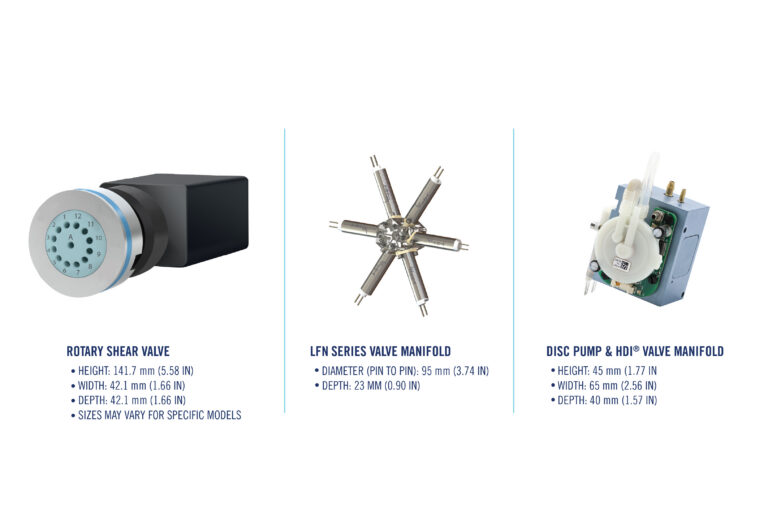
Valve manifold solutions can offer meaningful size advantages over rotary shear valves.
Syringe pumps tend to scale poorly with channel count (each line typically needs its own pump), and refill cycles risk backflow and disturbances. Switching to a pressure-driven flow pneumatic approach is a great option for designers navigating size constraints – a single pressure rail can feed multiple channels via flow restrictors or valves. Our disc pumps are only 29 mm in diameter and offer extremely high precision control. They can be packaged with electronics, pressure sensors, and solenoid valves in a manifold measuring just 45 mm x 65 mm x 40 mm – this becomes a compact pressure source and regulator all-in-one, capable of reversing flow direction between vacuum and pressure.
Reagent costs can add up quickly in high throughput labs. To minimize fluidic costs, many designers turn to zero-dead-volume syringe pumps. Our media-separated solenoid valves are also engineered to minimize dead volume, making them a compelling alternative to rotary shear valves in some cases.
Engineers who are considering making the switch from rotary valves to solenoid valves will also be pleased to know that our Xover pinch-tube solenoid valve can be flushed with up to 32% less volume than competitor offerings (like rocker-style valves) and our LFN Series valve has zero dead volume.
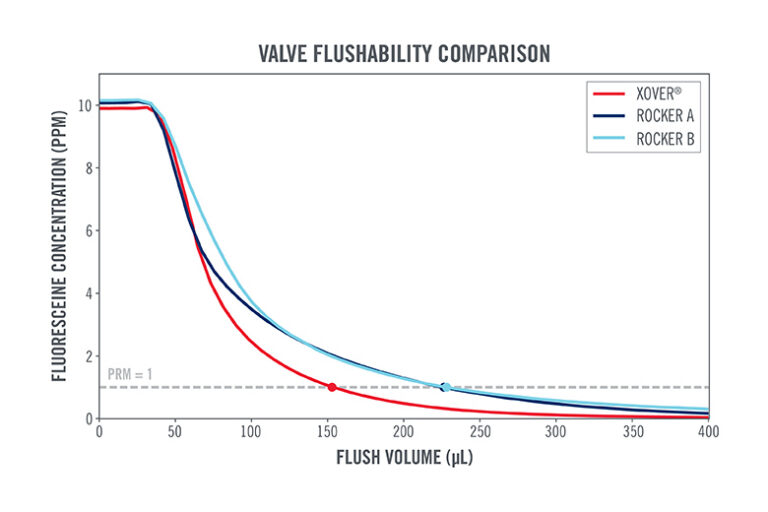
Flushability of the Xover valve is compared to that of two traditional rocker-style solenoid valves. Xover requires 32% less volume than the next rocker valve to flush from 10 PPM to 1 PPM.
A pneumatic pressure-driven flow architecture also offers zero dead volume. When a disc pump is used in these systems with a pressure sensor and flow sensor, it’s possible to monitor the fluid resistance on-chip – providing insights into the biological and mechanical changes happening inside the chip. This allows real-time adjustments that may salvage instrument runs or experiments.
The disc pump also provides ultra-smooth, low shear, laminar flow streams which may improve on-chip reactions and simplify microfluidic workflows by:

It is possible to achieve extremely precise fluid control when using pressure driven flow to dispense droplets onto a chip.
These more efficient, consistent on-chip chemistries may lower costs by enabling the use of less expensive or challenging fluids, simplifying workflows with less troubleshooting, and ultimately saving time through higher throughput.
By reevaluating traditional microfluidic device system architectures and considering alternative approaches, designers can unlock meaningful savings. The most efficient microfluidic systems are built for application-specific priorities. Whether you need to improve reliability, reduce reagent consumption, or expand your system’s capabilities, exploring alternative fluid control architectures can help you achieve your goals.
Click here to explore schematics and review the trade offs associated with common system architectures when moving fluid to and through a flow cell.
Our engineers routinely work with sequencing, spatial biology, and PCR system designers to find solutions for overall fluidic system cost reduction. With 75 years of experience solving our customer’s toughest fluid control challenges, it’s likely that we already have the precise flow control solution you need. If not, our engineers can modify our COTS components to fit your specific requirements without significantly impacting cost or lead times.
Lee engineers specialize in working with customers on an engineer-to-engineer level to navigate engineering challenges with confidence. Our global presence allows us to deliver local technical support that keeps development moving and innovation on track. Every Lee component is 100% functionally tested to ensure performance throughout your system’s lifecycle. Together, these strengths accelerate your path to market with components you can rely on.
Let us help you mitigate risk, optimize performance, and bring your medical innovations to life. Connect with a Lee Sales Engineer today to discuss your diagnostic application.
Tween® is a registered trademark of Croda International PLC (or Croda Americas, Inc.).
Always verify flow calculations by experiment.
*There are many parameters to consider when determining V-Factor. Click here for more information.


